
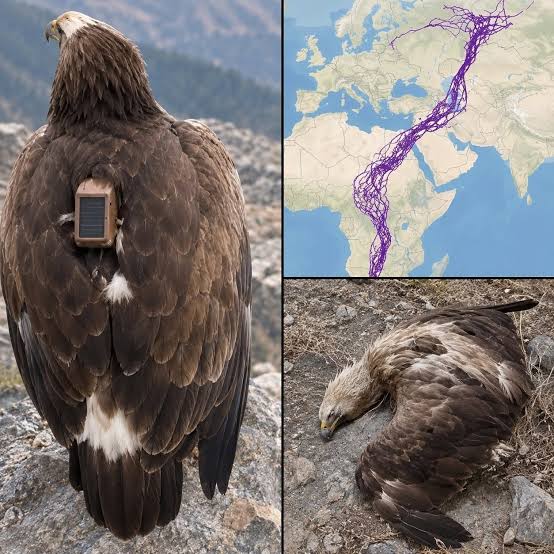
A photograph of a GPS-tracked eagle and a mysterious map covered in winding lines captured the attention of people around the world. The story seemed almost unbelievable: an eagle had supposedly been tracked for 20 years, traveling across several countries before finally dying in Saudi Arabia.
But there was something unusual about the map.
The bird appeared to avoid large stretches of open water, taking long detours across land instead. Why would an eagle travel such enormous distances rather than take a seemingly shorter route?
The image sparked thousands of questions and became one of the internet’s most fascinating wildlife stories.
However, the real scientific discovery was even more interesting than the viral version.
The Map That Confused Everyone
When the image began circulating online, many people believed it showed the complete migration history of a single eagle over two decades.
The purple lines stretched across an enormous region, connecting parts of Central Asia, the Middle East, and Africa.
At first glance, the routes looked like the journey of one extraordinary bird.
But researchers eventually clarified that the map did not represent one eagle’s movements over 20 years.
Instead, it showed the migration routes of approximately 20 young steppe eagles tracked during a research project in 2018.
Each bird had its own GPS transmitter, allowing scientists to monitor its movements over several months.
A misunderstanding in how the information was translated helped turn the scientific map into a much more dramatic internet story.
What Scientists Were Actually Studying
The birds belonged to a species known as the steppe eagle, scientifically called Aquila nipalensis.
These large birds of prey migrate across vast regions between their breeding and wintering areas.
Scientists wanted to understand where they traveled, which landscapes they used, and what challenges they encountered along the way.
Small tracking devices






Comments